
Turning point in sight for development feasibility across Australian commercial property markets
Australia – Economic rents – the level of rent at which construction of a new development becomes feasible - have surged since 2021, creating a significant barrier to new construction across in commercial property markets, according to Knight Frank’s latest research.
25 February 2026
The firm’s Australian Horizon 2026 highlights that the surge in economic rents stemmed from a “perfect storm” of rising construction costs, higher yields, increased tenant incentives and falling capital values, which have collectively reshaped feasibility thresholds.
The gap between economic rents and forecast market rents remains substantial in most office markets, with the Melbourne CBD the largest (56%), followed by Sydney (26%), Adelaide (20%) and Brisbane (12%).
Industrial economic rents are also above forecast rents however the gap is much smaller than in offices, reflecting strong rental growth and tighter yields for industrial assets, which has offset the growth in input costs to a greater extent. Sydney and Brisbane are the closest to feasibility, with economic rents stabilising at an estimated 14% and 13% above forecast rents respectively, while the gap in Melbourne is larger at 25%.
Knight Frank Chief Economist and report author Ben Burston said: “For developers, the hurdle to start new projects has never been higher, which will constrain the supply pipeline across all property sectors.
“We are already seeing this taking effect in office markets, with a rapidly diminishing pipeline of new development around the country, with completions forecast to reach record lows by 2028 because of the lagged impact of decisions made this year to delay new starts.
“The situation is less acute in industrial markets, but completions across the major East Coast markets are forecast to drop to 2.0 million square metres in 2026, well down on the peak level of 2.6 million square metres in 2024.
“The emerging supply shortage will drive prime rent growth in coming years as tenants will face fewer new-build options, and over time this will aid a wider office market recovery.
“Across both sectors, we expect to see more refurbishments as an alternative route to bringing stock upgrades to market, and developments that do proceed will be largely confined to core precincts where higher rents can be achieved.
While new projects remain largely unfeasible for now, the market appears to be approaching a turning point, said Mr Burston.
“Economic rents have likely peaked in most markets, with interest rates having fallen and prime yields starting to edge inward,” he said.
“We expect the gap between economic rents and forecast rents to start to close, albeit at different speeds.”
Mr Burston added that yield compression stands out as the likely catalyst for change in the development landscape, shaping the future path of economic rents.
“Put simply, when yields fall, asset values rise, and the economic rent required to make a project viable comes down, unlocking the door to new development,” he said.
“Without this compression, only exceptionally strong rent growth would be enough to tip projects into feasibility, making the journey to new supply far more challenging and potentially prolonging the current slowdown.”
When will the gap between economic rents and forecast rents close?
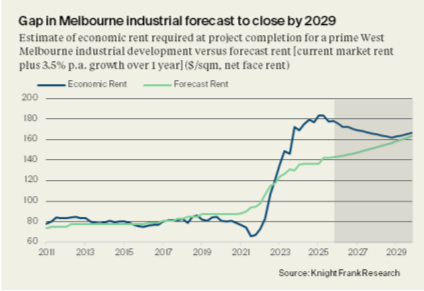
Knight Frank’s Australian Horizon 2026 report forecasts that the gap between economic rents and forecast rents for Sydney CBD premium developments will close by 2028, while for a prime West Melbourne industrial development it’s forecast to close by 2029.
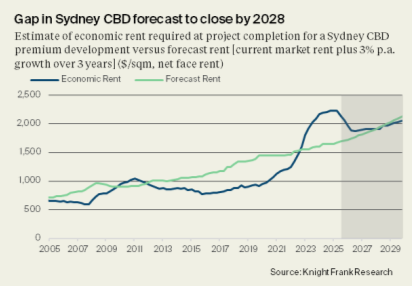
Mr Burston said there are signs of progress for premium developments in the Sydney CBD, with economic rents in Sydney having started to fall, off the back of a 25 basis point reduction in prime yields in Q3.
“A further 50 basis point compression for premium offices is expected to be the lever that finally brings new development back within reach, and the process is already underway, with premium yields dropping by 25 basis points in Q3.”
A similar story is unfolding in Melbourne’s prime industrial sector, according to the report. Here, economic rents are expected to stay above forecast rents until around 2029.
“This outlook is shaped by a forecast decline in industrial yields and a projected pickup in rental growth in 2027, as the slowdown in new supply gradually reduces vacancy rates and tightens the market,” said Mr Burston.
“However, the slowdown in industrial supply will not be as dramatic as we are seeing in office markets, because many developers acquired land several years ago at lower rates, so are better able to navigate the spike in construction costs.”